
Warfighters – past, present and the future is you
Full Throttle Hiring. Will you be the next to leave your legacy?

You could be next.
As Robins Air Force Base, through its Full Throttle Hiring program, seeks new employees, will you be the next generation or the one carrying on the family tradition of being an invaluable member of its workforce? Its history? Its heritage? You.
Two examples that have left their mark: Ben Poole and Ethan Nipper.
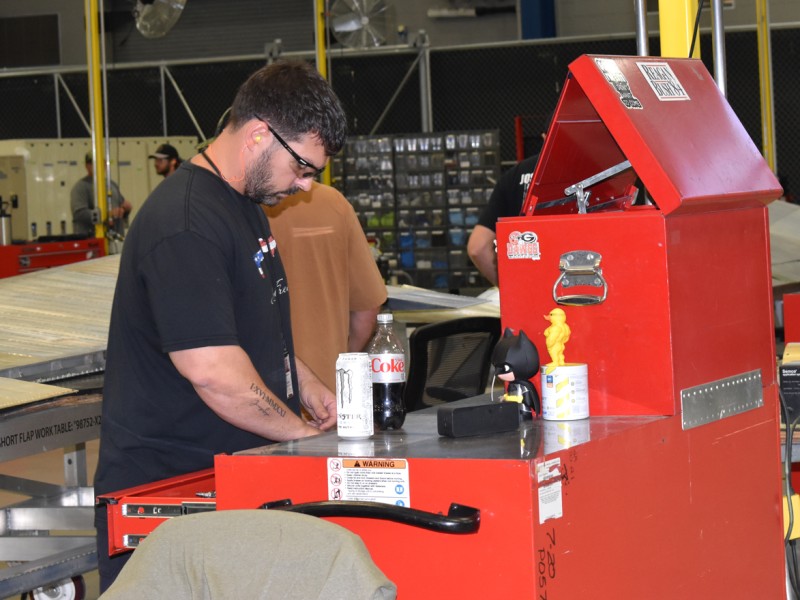
Poole is the Deputy Squadron Director and Nipper the Production Supervisor for the Robins Air Force Base Commodities Maintenance Group employees who operate out of the building located next to the Macon Airport. (Sharing space with the Central Georgia Technical College Aerospace Training and Sustainment Center.)
Both had at least one parent and/or parent and grandparent who worked on Robins.
“So,” said Poole, who has been a Robins employee for 16 years, “I grew up in the area, and just as a kid, everybody wanted to work on base. So, I spent six years out of high school, just doing random jobs and decided I wanted to pursue a career. And if you’re from Warner Robins and plan to stay in Warner Robins, Robins Air Force Base is the best option.”
He went through the 18-month co-op program with Central Georgia Tech, came in as a “kind of like an apprentice technician,” sheet metal mechanic. He was a Wage Grade 3 employee at the time. “And then you do a couple of rounds of school, then work, then school, then work, and then you get picked up as a full-time WG-8 mechanic.”
That first experience, he said, was “eye-opening. You don’t really quite understand, before you’re actually doing the job working on aircraft. You don’t really understand what goes into it as far as like all the different procedures and technical data that you have to follow.
“And, you know, a lot of the, as a mechanic, you know, I’ve always worked on cars, worked on lawn mowers, worked on stuff and you can get by with good enough. But that’s the main change when you’re coming out here. You’re actually working on aircraft. Good enough doesn’t cut it.
“It’s got to be to the ‘T’, to the letter. I mean, we’ve got technical guidance which breaks out every single step that we have to do and we have to do it exactly per that.
“So that’s the main thing. Just knowing there’s expectations out here, there’s guidelines, and they have to be followed. And that’s one thing that hasn’t changed in the 16 years I’ve been out here and will not ever change.”
He worked on aircraft for 10 years before moving up the leadership chain. That included working on C-5 engine cowlings, C-130 flight controls, and with the majority of his career, he said, spent as a propeller mechanic working on the C-130 propellers.

Nipper was born and raised in Perry. His path to Robins was through Georgia Southwestern. He attended it, he said, for two years and also got in the co-op program. It turned out to be critical timing. “There was like sixty kids and they took two. So, I was really fortunate to get in because after that, I think they hired one more round and then they didn’t hire for a couple of years.”
As his career advanced he went back to school, graduated with the AST program where he received an aircraft structural certificate and then got on full time, also as a WG-8. He was a mechanic for about six years – C-130 from short and long flaps to cargo ramps, doors, scoops and hatches, miscellaneous and flight control – before getting promoted to a work lead. He was a work lead for three years before being promoted to a first-line supervisor and then his current role. This is his sixth year in that role.
Here’s where the: “You could be next” comes in. They fill a critical role and Robins needs more of them.
“We’re constantly, as many people as we have in our world culture, constantly losing mechanics. As far as the whole base is concerned, the most important people to work out here are the mechanics, right? Everybody else is overhead.
“Mechanics are the ones who are actually touching the assets, touching the aircraft. overhauling the parks and the planes. They’re the reason we’re all here.”
So, there are a few candidates that play well on their radar – not that “any” candidate isn’t a welcome sight. Experience is one. Former military. Age.
“We definitely like to see a younger generation. We invest a lot of resources and a lot of time training and hands on. And not that we don’t hire seasoned people, older people, but somebody that’s coming out here for two or three years, it’s just you get to a point where you’re, I’m going to say wasting a lot of resources, for lack of a better word.
“So obviously we like the younger people, and the easiest thing is just to get in the tech school. It’s minimal cost. They have day classes. They have night classes that work around– most people are currently working, so they work around that.
“They have online things. It’s super easy to complete that little 18-month program. And once you get that, once you get that, you come to an interview, you’re just about guaranteed a job. It’s just you got to go through the course at the school.
“It’s hard to hire people that have no, that don’t even know what a fastener is, or a rivet or a rivet gun. Now, we might get to the point where that’s what we have to hire, but right now, we’re kind of in the process of young adults that have completed this program that have the basic knowledge of what they need.
“And we just kind of build off of that versus just trying to start from the floor up. But I tell people all the time, it’s too easy not to do it if that’s what you want to do.”

It is an extremely critical job. Understatement!
“I mean, with everything going on in the Middle East,” Nipper said. “I mean, our director always tells us, like your whole career out here, you practice for war. You know, you’re practicing for war, keeping things ready in case you go to war.
“Well, right now, we’re at war. You’re not practicing anymore. You know you see these planes flying overseas and on the news channels and this and there’s this sense of importance knowing that you’re working on what’s flying these airmen around.”
Added Poole: “I mean stressing the importance of the job is something that we focus on because that really gives people – I know when I was a mechanic, once you understand how important your job is, you’re really going to get a lot more fulfillment out of what you do, which is, in my opinion, that’s just as important as a paycheck.
“Everybody comes to work to get paid, obviously. That’s why we all do it. But if you can have a job where you actually feel like you make a difference and you’re doing something that is worthwhile, it just makes it better.
“We contribute to a lot of different things, be it warfighting missions or humanitarian missions all over the world. Our people have direct influence on those things that happen all over the world.”
Apply today and you could be one of them.

Before you go...
Thanks for reading The Houston Home Journal — we hope this article added to your day.
For over 150 years, Houston Home Journal has been the newspaper of record for Perry, Warner Robins and Centerville. We're excited to expand our online news coverage, while maintaining our twice-weekly print newspaper.
If you like what you see, please consider becoming a member of The Houston Home Journal. We're all in this together, working for a better Warner Robins, Perry and Centerville, and we appreciate and need your support.
Please join the readers like you who help make community journalism possible by joining The Houston Home Journal. Thank you.
- Brieanna Smith, Houston Home Journal managing editor
Paid Posts
Related Articles
Robins AFB launches ‘Full Throttle Hiring’
Robins AFB is actively seeking to hire approximately 600 people through its “Full Throttle Hiring” program.
Great futures STEM from Starbase Robins
Starbase Robins offers education and fun.